

Exploring an integrated solution to colorectal cancer
The Cabrini Monash University Department of Surgery brings together scientists and specialist colorectal surgeons to discover new approaches to colorectal cancer.
Across basic, translational, and clinical research, the Department works closely with the Monash Biomedicine Discovery Institute to better understand the complex biology of colorectal cancer (CRC), the third most common cancer type globally and the second leading cause of cancer death in Australia.
The Department has been central in driving national efforts towards improved care models for CRC patients, notably the Cabrini Monash Colorectal Neoplasia Database (CMCND), which has gone on to become the principal reference dataset for CRC as the Cancer Outcomes Registry (BCOR).
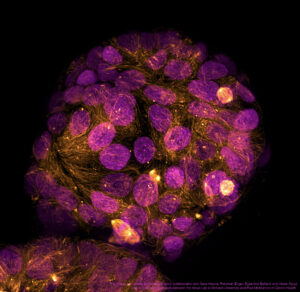
Image from Dr Horace Chan in collaboration with researchers from Abud Laboratory and CMUDS.

Diseases
Colorectal Cancer

Approaches
Clinical Trials
Health Systems Optimisation
Molecular Multiomics
Organoids and Spheroids
Patient-Reported Outcomes Measures
Surgical Methods
Tumour Microarrays

Research Themes
Health Informatics
Integrative Cancer
Precision Medicine
Translational
Department Researchers
Academic Researchers
Dr Christine Georges
Professor Paul McMurrick
Dr Simon Wilkins
Clinical Researchers
Associate Professor Stephen Bell
Dr Peter Carne
Dr Martin Chin
Dr Chip Farmer
Dr Joe Kong
Dr Pravin Ranchod
Dr Paul Simpson
Dr Raymond Yap
Research Fellows
Dr Lauren Cohen
Dr Christopher Steen
Interested in learning more?
Department Research Themes
Colorectal Cancer Organoids
A collaborative initiative with the Monash Biomedicine Discovery Institute’s Epithelial Regeneration Laboratory, the Colorectal Cancer Organoid Program stands at the forefront of personalised colorectal cancer treatment in Australia. Utilising laboratory developed organoids that mimic patient tumours, treatment sensitivities can be predicted for each patient with unprecedented accuracy. Today, the Program identifies rectal cancer patients likely to demonstrate a complete response to chemoradiotherapy, eliminating the need for radical, invasive surgery. In the future, broader application of these organoids will shift models of colorectal cancer care towards non-surgical approaches.
Cabrini Monash Colorectal Neoplasia Database
Established in 2006, the Cabrini Monash Colorectal Neoplasia Database (CMCND) is an extensive cloud-based library of clinical data. It has driven the Department’s data-driven research workflows, which continue to seek out innovations that optimise clinical approaches and patient outcomes for CRC. Since the CMCND’s adoption by the Colorectal Surgical Society of Australia and New Zealand, it has evolved to become the Bowel Cancer Outcomes Registry to include over 170 participant sites. Today, it serves as a critical reference for evidence-based clinical decisions during the design and delivery of treatment strategies that best meet the specific needs of individual CRC patients.
Predictive Tissue Microarrays
Developed three decades ago, tissue microarrays (TMAs) offer a high-throughput, cost-effective method to evaluate multiple tissue sources simultaneously on a single histological slide. Their adoption into the Department’s translational and clinical research has aided in predicting treatment responses, which are highly heterogeneous amongst CRC patients, despite presenting with similar symptoms and tumour stages. This has not only guided clinical decision-making processes but have also helped in identifying and evaluating novel biomarkers that form the building blocks from which a new generation of diagnostic tools and therapeutic products can be developed.
Patient Reported Outcome Measures for CRC
As patient-centric care becomes standard practice in healthcare delivery, patient reported outcome measures (PROMs) have been increasingly used to capture and communicate patient perspectives regarding their symptoms and functionality. The Department has played a prominent role in developing standardised PROMs for CRC, shaping global guidelines through the International Consortium for Health Outcomes Measurement (ICHOM). These have already been implemented in hospitals across Victoria, including Cabrini, enhancing symptom monitoring and management, informing clinical decisions, and streamlining patient-clinician communication towards patient-centric care models in CRC.
Selected Publications
Ali Riaz Baqar,* Simon Wilkins,* Wei Chun Wang, Karen Oliva,* Suellyn Centauri,* Raymond Yap,* Paul McMurrick*
ANZ Journal of Surgery, April 2022
Personalized Medicine—Current and Emerging Predictive and Prognostic Biomarkers in Colorectal Cancer
Christine Koulis,* Raymond Yap,* Rebekah Engel,* Thierry Jardé, Simon Wilkins,* Gemma Solon, Jeremy D Shapiro, Helen Abud, Paul McMurrick*
Cancers (Basel), March 2020
Ali Riaz Baqar,* Simon Wilkins,* Margaret Staples, Chun Hin Angus Lee,* Karen Oliva,* Paul McMurrick*
International Journal of Surgery, April 2019
Thierry Jardé, Wing Hei Chan, Fernando J Rossello, Tanvir Kaur Kahlon, Mandy Theocharous, Teni Kurian Arackal, Tracey Flores, Mégane Giraud, Elizabeth Richards, Eva Chan, Genevieve Kerr, Rebekah M Engel,* Mirsada Prasko, Jacqueline F Donoghue, Shin-Ichi Abe, Toby J Phesse, Christian M Nefzger, Paul J McMurrick,* David R Powell, Roger J Daly, Jose M Polo, Helen E Abud
Cell Stem Cell, October 2020
* denotes Cabrini researcher