

A million reasons to listen
18/06/2026
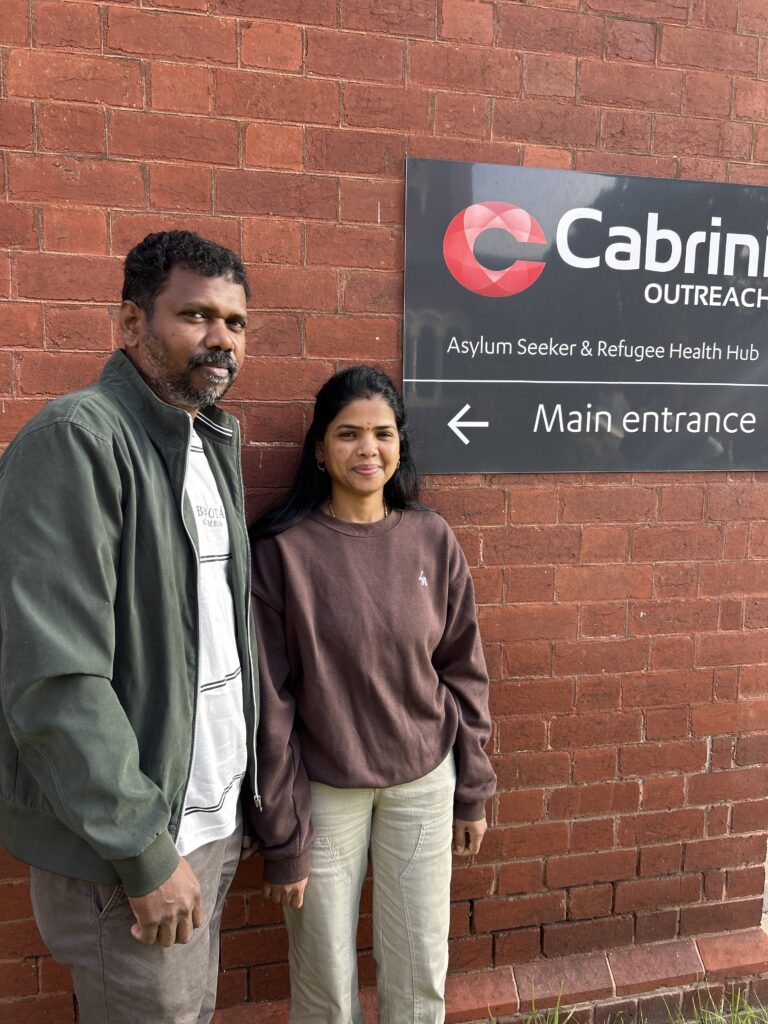
This week, as Australia observes National Refugee Week 2026, the Cabrini Asylum Seeker and Refugee Health Hub also marks a decade of providing compassionate care to some of our community’s most vulnerable people.
Since opening its doors in 2016, the Hub has helped about 1700 clients. For each of them, it represents a point of contact in an unfamiliar country, a place where physical and mental health needs can finally be met and where they can be treated as an equal.
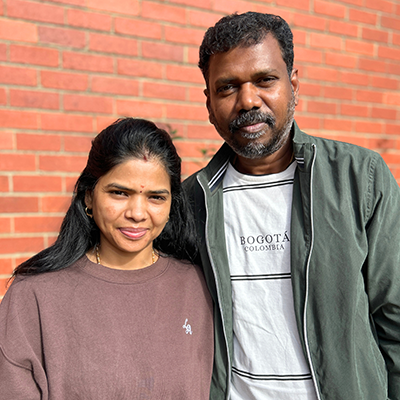
Currently, our Hub looks after 426 clients, each with their own unique stories to tell. One of those stories belongs to Sangeetha and her husband Swergeswaran.
When she was just three years old, Sangeetha and her parents fled to India to escape the civil war in Sri Lanka. By then, her family had already lost many relatives to the conflict. For the next 22 years, they would live in refugee camps in India.
“The way they treat you, it’s like whatever you do, you never get treated as a person,” Sangeetha says. “They don’t look at you like a human, they just think ‘refugee’.”
Swergeswaran had grown up facing his own profound losses, having lost both parents to the same conflict as a teenager. After the two were married, he believed it was no longer safe to stay. When attempts to travel to France, where his brother was living, proved unsuccessful, he set his sights on Australia.
“He wanted to come himself to Australia by boat,” Sangeetha says. “But then I felt like, whatever happens, we don’t know if he will be alive or not. So, I thought, if you’re taking the risk, we are family, we will come with you.”
In 2012, together as a family, they left India and began the journey to Australia with their two young sons, aged seven and four.
“We came 18 days by boat here,” Sangeetha says. “We never thought we’d be alive here like this.”
Upon arrival, they lived on bridging visas and faced ongoing uncertainty about their legal status. Then in 2024, they lost their work rights due to visa issues. The challenges that followed hit their mental health hard.
“Suddenly, it’s like you become in a dark room. We have nowhere to go now, nowhere to turn,” Sangeetha says.
Swergeswaran’s health, both physical and mental, began to decline. It was at this point that a friend told them about Cabrini.
“Oh, that’s a very beautiful story,” Sangeetha says. “Finally, we come here, after the first meeting, we felt like we have somebody to look after us. We had that connection after the first meeting. That’s the best thing in our life since we came to Australia.”
That sense of connection is something the Hub’s nursing team works hard to build from the first appointment. When a new client arrives, the team conducts a comprehensive health assessment, gathering physical and medical history alongside the psychosocial background that shapes a person’s overall wellbeing.
From there, the team coordinates vaccinations, follow-up care, wound care and specialist referrals, while also supporting clients through practical challenges like housing, income and legal needs.
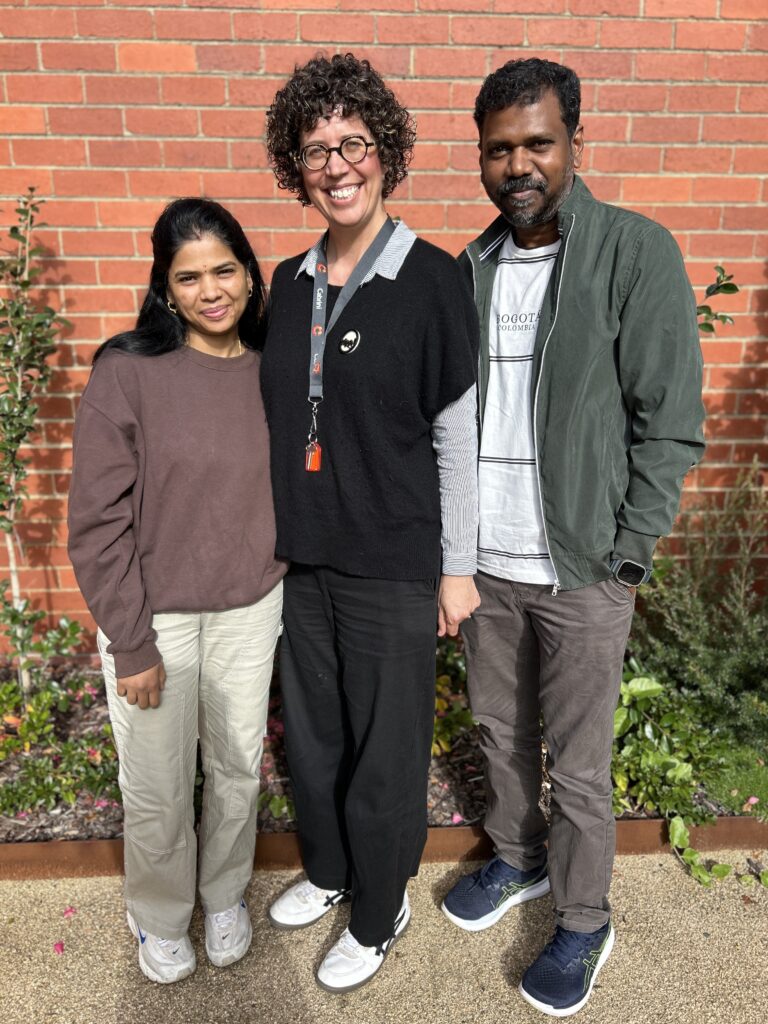
Sangeetha and Swergeswaran with Christine
Christine Parrott, nursing team leader in the Cabrini primary health care team, believes the ability to spend genuine time with clients is one of the things that makes the Hub unique.
“I think what’s really nice about us, compared to, say, a regular GP service, is we are able to spend a lot of time with our clients,” Christine says. “I think that’s one of the beauties about this service.”
For Sangeetha, that time and attention have made an enormous difference to her family’s wellbeing.
“It’s a huge impact from Cabrini. My husband was mentally unwell at the time we came,” she says. “Dr Trish, she was very amazing. She’s always asking what is going on, it’s like a family thing. We didn’t have that connection for so long.”
Incredibly, Sangeetha and her family have recently been granted their permanent visas.
“We got our green Medicare card now and travel documents are on the way,” Sangeetha says proudly. “Everything’s changing and you can’t believe it. We didn’t get anything easily. Now we get a new feeling. Both boys are very excited, they want to go out, they want to see the world. Finally, we have a country to call home.”
Her boys are now 21 and 18, far from the small children who made that ocean journey 14 years ago. With permanent residency secured, the future has opened for them in ways the family had never dared to imagine.
“When my son lost his ability to study, he was very depressed,” Sangeetha says. “Now he wants to do biomedicine. He wants to be a doctor. My second son, he wants to serve the country and go into the army. He never had that plan before.”
Now, Sangeetha is thinking about the people she loves who are still waiting. Her parents, aged 75 and 60, have spent the last 34 years living in a refugee camp, still in India. She hopes to bring them to Australia one day soon.
“I want to show them that there’s a quality of life here,” Sangeetha says. “I want to see them enjoying a real life, because their life there, it’s a struggle.”
Sangeetha also wants to give back. She is now an organ donor, a decision she made as an act of gratitude for the country she now calls home, and she hopes to volunteer at the Hub one day too.
“I want to do something, even my family, everybody wants to do something, we’re ready to help.”
For the Cabrini Asylum Seeker and Refugee Health Hub, Sangeetha and her family’s story is proof of what is possible when people are treated with consistency, dignity and compassion.
“Everywhere we went, doorways closed, but here they welcome you,” she says. “Without Cabrini, I don’t think we could have come this far.”