


Cabrini contributes to important transfusion registry
03/12/2025
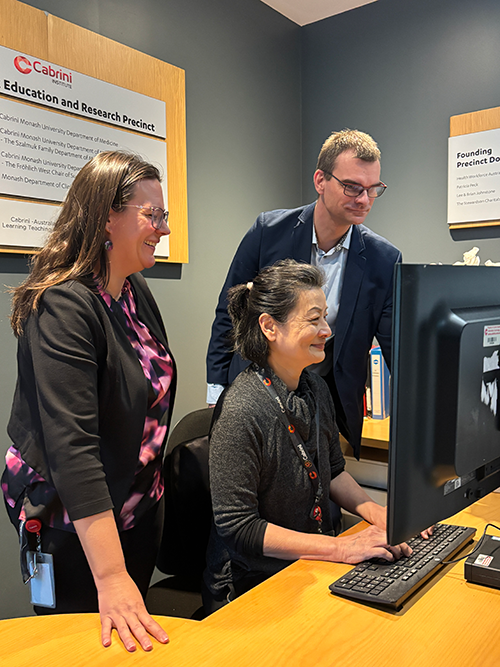
L-R Cabrini’s Stefanie Elbracht-Leong, Dorina Heng and Arne Protz
Cabrini is the first private hospital to contribute data to the National Transfusion Dataset (NTD) – a database that describes numbers and characteristics of patients who have a blood transfusion prehospital, in hospital, or in the community.
Research indicates that one in three Australians will require a blood transfusion at some point in their lives, a statistic that highlights the importance of accurate data.
This significant national database registers how and why blood products are used and the clinical outcomes of patients who undergo transfusion. Participation will have many benefits, Interim Group Director of Medical Services and Clinical Governance Associate Professor Vineet Sarode said.
“At Cabrini, we contribute to lots of registries, including cardiac surgery, cardiology and ICU registries,” he said. “For us, it’s a really good way of making sure we’ve got good quality benchmarking about our outcomes and activity.
“So, we’ll know from this registry if we are transfusing too much compared to our peer hospitals, or if we’re doing less – basically how we sit compared to our peers – and will be able to track things like wastage.
“Our data will then help in setting up the guidelines in terms of when we should use blood products, what type of blood products, how much blood product, and what tests we should be doing for transfusion. This work will have a direct impact on patient safety and outcomes.”
Significantly, researchers will also have access to the important data contained in the registry.
Setting up the project began a few years ago.
“It took a long time and a lot of work to get the data sorted and to ensure that all data is de-identified before it’s entered into the registry,” Vineet said. “But I’m excited that we’re now at the point where every single blood transfusion we do at Cabrini is recorded.
“Big thanks to Arne Protz, Dorina Heng and Stefanie Elbracht-Leong for all their hard work in making this happen.”