


How planning and practice saved Simon’s life from deadly DVT
08/04/2026
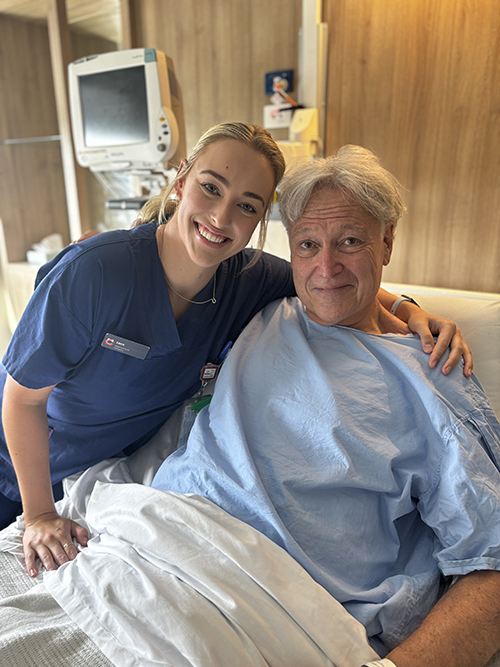
Cabrini Emergency Department nurse Laura with patient Simon Vinson
When Simon Vinson’s blood pressure dropped and the pulmonary embolus that was dancing around his right atrium stopped his heart from beating, our Emergency Department team kicked into action to save the Malvern East man’s life – without skipping a beat.
Despite never having seen an embolus quite as large before, the ED team, led by Dr Melanie Bennett, had a plan in place and was ready for any contingency.
“We plan, we prepare and we simulate, so that when we do have to respond in an emergency situation, we’re ready,” Melanie said.
Four weeks earlier, Simon had pierced his calf while gardening but the father of two thought nothing of it. When he experienced “excruciating pain” in his leg some weeks later, he saw a sports medicine doctor, who told him he needed to have an MRI. The scan revealed a deep vein thrombosis (DVT), so Simon’s partner Jane insisted he urgently attend Cabrini ED.
That’s when things took a scary turn.
“We could see as soon as Simon arrived that he was very unwell,” Melanie said. “We scanned Simon and found there were multiple clots in his pulmonary circulation, and then a scan of his heart revealed a large pulmonary embolus (PE) was dancing around in his heart, which is very dangerous.
“In all my years in emergency medicine, I’d never seen a PE like that in real time.”
Simon’s life was in the balance with limited options available, so Melanie quickly established a plan, and her team was ready for any eventuality.
“We consulted with our cardiac surgeons, our haematologists and our intensive care specialists, and agreed that we should give Simon a clot busting drug,” she said. “We knew that came with risks, but we were well prepared. This is what we train and simulate for.”
Before the clot had fully dissolved, the feared complication occurred and Simon went into cardiac arrest. Nurse Laura Smythe had observed Simon’s blood pressure drop, and, as planned, instantly called for assistance.
ED doctor Dr Kang Lim was on hand and performed manual CPR for three minutes before Simon’s heart restarted. Extraordinarily, two hours later, Simon was sitting up in his ICU bed ordering dinner.
“It was a fantastic team effort,” Melanie said. “We all knew exactly what could happen, and what our roles were in any event, and we executed the plan really well. Seeing Simon doing so well is a testament to how well everyone in our team did their jobs.”
For Simon, who turned 70 last Monday, just five days after his heart event, he couldn’t be more grateful to the team that saved his life.
“It was my birthday on [the] Monday, but [the] Wednesday [before], I might not have seen another birthday, but for the staff here in Emergency at Cabrini,” Simon said.
“I owe them my life.”
Simon spoke to Channel 9 News to share his gratitude and to raise awareness about the dangers of deep vein thrombosis.
“If I’d delayed another day, I probably wouldn’t be here at all,” he said. “If in doubt, do not hesitate, get to hospital, and then let the professionals see what can be done. It may well save your life.”
Simon’s haematologist, Associate Professor Kirsten Herbert, said there are a number of red flags to be aware of when it comes to DVTs.
“It’s important to seek medical help if there is any asymmetry of your limbs,” she said. “If there’s swelling in one leg, discolouration, redness and heat, or even shortness of breath and chest pain, they are all signs that shouldn’t be ignored.
“And definitely don’t ignore things if they’re persisting.”