


Women-only approach to mental health care works
20/05/2026
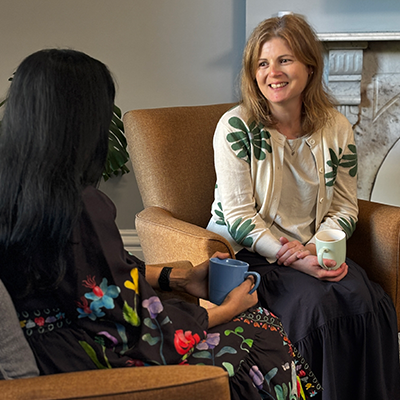
Cabrini Women’s Mental Health patient Tanya is living evidence that the Program run out of our Lisa Thurin Women’s Health Centre in Elsternwick can be life-changing.
At the weekend, the mum-of-two publicly shared her story on SBS World News, a story that is testament to the success of the model of care that has been implemented at the women-only Centre.
“I arrived here in a very diminished capacity,” Tanya said. “So, I had gone from being a full-time working mum with teenagers. And I just ended up barely able to go to the supermarket. I was in a really bad way. I had to take time off work and then I just couldn’t go back. I was very much struggling.”
Tanya participated in the two-week inpatient program, and then our six-month outpatient program, and she continues to use art therapy as part of her recovery.
“Doing art therapy is really satisfying, soul-soothing,” she said. “It helped me to find ways to express what I am feeling. I’ve spent my life using words, words, words, and here I learned about non-word expression. It just felt really satisfying and soul soothing.
“Now I feel really good and have a better understanding of myself.”
Late last year, Professor of Psychiatry and founding medical director of Cabrini Women’s Mental Health, Professor Jayashri Kulkarni, co-authored a review in Australasian Psychiatry that found our women-only mental health program not only works and is reproducible, but that structured women-only mental health care is essential for the one in four Australian women who battle with severe mental health challenges.
“This Cabrini model is serving as the blueprint for future women’s mental health care,” she said. “It’s about the compassionate way of providing mental health care, but also cutting-edge mental health care, such as with the hormone strategies.
“But, at the end of the day, I’m just really proud of the women [who use our service]. Every time we can just add a little bit more to the quality of life of somebody, I’m very proud that we’ve been on that journey with her.”
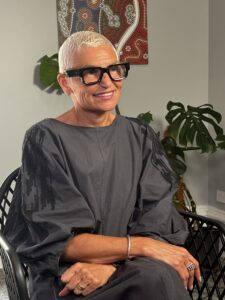
Sharon Sherwood
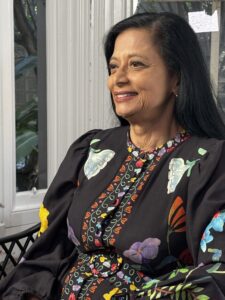
Professor Jayashri Kulkarni
Cabrini Chief of Mental Health and Outreach Sharon Sherwood, who also participated in the SBS story, said more than 1000 women have now participated in our program.
“We have between 130 and 150 women participating in our inpatient and outpatient programs at any one time,” Sharon said.
“We use all these therapeutic modalities that are very gendered around females and the female experience rather than a generic mental health model. We use DBT (Dialectical Behaviour Therapy), Cognitive Behaviour Therapy-oriented programs (CBT) and EDMR (Eye Movement Desensitisation and Reprocessing), but we also incorporate physical health in our programs, and art and music therapy, and spiritual care.
“Everything about the Program has been carefully considered – from the trauma-informed therapies we use, our staff, and the spaces. It’s a beautiful female-focused Centre with single rooms and ensuites, lots of natural light, and importantly, we’re a safe environment for women.”
SBS World News TV story
Audio SBS story and transcript
Digital SBS story