


Trusting the process
29/07/2026
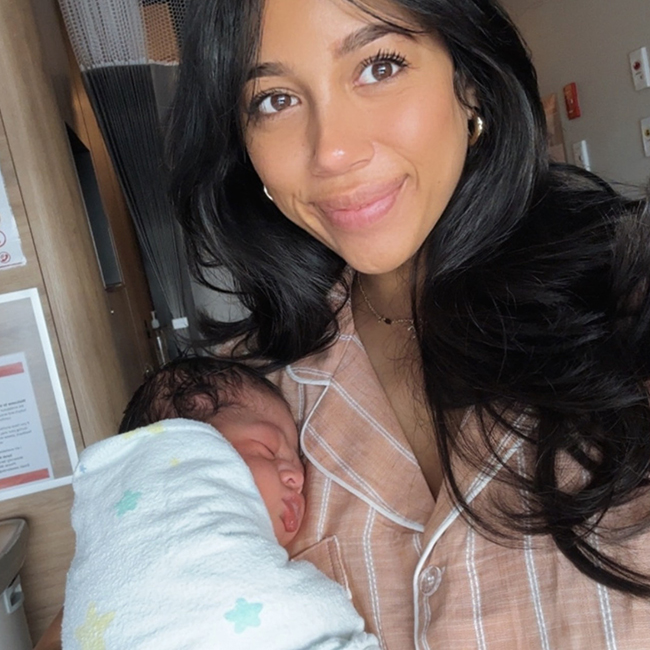
When her first birth resulted in an emergency caesarean, Hasnaa knew she didn’t want to miss out on a natural birth when she became pregnant with her second child. She had been prepared for a natural birth the first time around, but when complications arose, everything had to happen quickly.
“I was really disappointed when I couldn’t have a natural birth and needed an emergency caesarean” Hasnaa said.
“When she moved house and had to find another obstetrician for her second pregnancy, she knew she wanted one who was confident in supporting a vaginal birth after caesarean (VBAC) which is when she met with obstetrician A/Prof Shavi Fernando at Cabrini.
“I met Shavi, who explained everything and went through the risk factors,” Hasnaa said. “Thankfully, he gave me all the information I needed to choose a VBAC.”
A VBAC is a vaginal birth after a caesarean, sometimes referred to as a trial of labour after caesarean.
“It’s basically when a woman has had a caesar before and is then, in a subsequent pregnancy, attempting a vaginal birth,” A/Prof Fernando said.
Most women who have had one straightforward, lower-segment caesarean are candidates for a VBAC as long as the caesar was uncomplicated. In general, VBACs are appropriate for most women, with the main exclusion factor being the circumstances that led to the previous caesar, and how many caesars they’ve had before.
“A common misconception is probably the chance of complications,” A/Prof Fernando said. “The chance of a major complication happening is quite low. Probably the commonest risk is that a vaginal birth doesn’t eventuate, and you end up having to have a caesarean regardless.”
According to the Australian Institute of Health and Welfare, 11 per cent of women who have a caesarean for their first birth go on to have a VBAC for their second.
For Hasnaa, the decision was about more than just a birth preference.
“I have a toddler at home,” she said. “I really wanted to have the freedom of movement and a quicker recovery time, so I could still be an active mum.”
When labour finally came around, Hasnaa’s biggest fear was history repeating. During her first pregnancy, she had been rushed to hospital with heavy bleeding at 38 weeks.
“That did happen during my labour again this time,” Hasnaa said. “Except Shavi was an absolute hero. He was so good, he monitored me and knew that I was really stressed out when I started bleeding again. He just reassured me that the baby was fine and that I could still go ahead with having a natural birth. So that was pretty special.”
Another thing Hasnaa remembers clearly is the team of midwives and nurses who helped see her through, including validating her preference for hypnobirthing.
“I had my birth preferences sheet, and I was really striving for hypnobirth and ideally, I didn’t want any other birthing experience besides that. Every nurse that came in, they knew everything about it,” Hasnaa said. “So, I didn’t have to advocate for what I wanted. It was just like, ‘yeah, we can do that, we’ve done that lots of times.”
This support was one of the most important factors during Hasnaa’s labour and delivery.
“The midwives were literally angels,” she said. “I had the best midwives when I was at Cabrini and by being the best, I mean they were godsends. Lizzie was just so calm and nurturing, Emma was so kind, she checked up on not just me but my husband as well, which I really valued. And poor Ella, I was sorry for her because she took over just as I started bleeding.”
But Ella handled it like a trooper. Remaining calm, she reassured Hasnaa that everything would be alright.
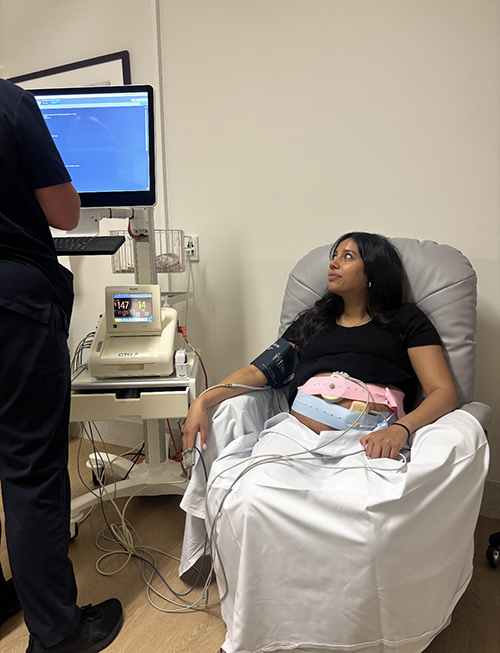
Some of the precautions in place for a VBAC include continuous heart rate monitoring of the baby and having an operating theatre close at hand.
“So, in other words, if something does go wrong,” A/Prof Fernando said. “We can get the baby out very quickly and safely. Having staff that are capable, competent, and confident in managing VBACs is important.”
What kept her out of theatre, Hasnaa believes, was Ella’s persistence in finding the baby’s heartbeat again and again, no matter Hasnaa’s position.
“Ella was so dedicated to finding the baby’s heartbeat every single time, which meant that Shavi was sure that everything was going okay and ultimately, I was able to have the birth that I wanted.”
A/Prof Fernando agreed, watching it unfold from the clinical side.
“Ella was doing an excellent job,” he said. “She was able to monitor the baby through the abdomen, and she was able to do that consistently, so we could manage her labour appropriately. The midwives were all very keen for her to have a VBAC, so they weren’t afraid of it, which was great. They were facing it head on.”
That calmness and professionalism matter more than people realise.
“If you’re in a situation where the team is less confident at managing something like a VBAC, the stress can be felt by the patient, and it can make the outcomes less favourable,” A/Prof Fernando said. “Just the calmness is really helpful in that setting.”
Hasnaa went on to have the birth she had hoped for, delivering her son, Raphael.
“I feel like it was one of the most empowering moments of my life,” Hasnaa said. “There’s no other experience like that. I go back and look at the pictures often, because they are just really, really special.”
Looking back, Hasnaa’s advice to other women considering a VBAC is simple: find an obstetrician you trust, and if you safely can, and it’s what you want, then go for it.
“If that’s something that they can and want to do, then definitely do it,” she said. “It’s something that my husband and I look back on so fondly. It was such a magical experience. And it’s not taken away from the caesarean at all. It’s just a different experience.”
A/Prof Fernando’s advice is for women to know themselves, but to trust their healthcare providers.
“It’s okay to be nervous about a VBAC,” he said. “Anyone considering one should talk to their obstetrician and their midwife about the merits and the risks, and then decide whether it’s right for them specifically, not based on anyone else’s story. I think if you satisfy the criteria to have a safe vaginal birth after caesarean, then I’d take those steps.”
For Hasnaa, her decision to have a VBAC was worth it.
“I loved my birth experience. It was so empowering and wonderful and just magical.”